


Case Studies
Southeast U.S. Manufacturing Company
The Challenge
Company was operating with an unstable, largely paper-based production planning process that provided limited forward visibility into demand, capacity, inventory, and material requirements.
Frequent schedule changes, low inventory accuracy, growing backorders, and missed due dates created a reactive environment across planning, purchasing, production, and warehousing.
My Role & Approach
During a six-month consulting engagement as Master Production Scheduler & Purchasing Coordinator, I was brought in to stabilize production planning, improve inventory control, and develop a more structured approach to manufacturing execution.
• Designed and implemented a digital Master Production Scheduling (MPS) system to replace the existing paper-based planning process
• Developed an integrated planning framework connecting demand forecasting, capacity, WIP, production scheduling, actual production, downtime, and material requirements
• Expanded forward production visibility by 5 weeks through structured scheduling cadence and capacity planning
• Built item-level demand forecasts using historical demand, open orders, and trend analysis to support forward production requirements
• Developed daily, weekly, and monthly production schedules aligned with forecasted demand, available capacity, WIP, and material availability
• Created planned-versus-actual production tracking and scheduling-adherence metrics to measure execution against the production plan
• Incorporated downtime and operational constraints into the planning process to improve visibility into schedule performance
• Increased inventory accuracy from approximately 70% to 95% through daily cycle counting, 5S organization, and improved transaction-verification processes across shipping, receiving, production, and sales
ENGAGEMENT AT A GLANCE
6 MONTHS
Consulting Engagement
95%
Inventory Accuracy
21%
Reduction in Backorders & Missed Due Dates
+5 WEEKS
Forward Production Visibility
DIGITAL MPS
Implemented

The Results
Achieved within six months:
• ~70% → 95% inventory accuracy
• 21% reduction in backorders and missed due dates
• 5 additional weeks of forward production visibility
• Replaced a reactive, paper-based scheduling process with a structured digital Master Production Scheduling system
• Established stronger alignment between demand, capacity, WIP, materials, production scheduling, and actual execution
• Created a repeatable planning framework that provided earlier visibility into potential production constraints and schedule risks
Key Takeaway
Production stability requires more than a schedule. It requires a connected planning system that translates demand into an executable production plan while accounting for capacity, WIP, material availability, and operational constraints.
By combining forward-looking planning with disciplined execution and inventory-control practices, manufacturing operations can identify problems earlier, reduce reactive decision-making, and create greater predictability across the operation.
What I created
Production Planning System
To replace a paper-based production planning process, a fully integrated Excel planning system was developed to connect historical demand, forecasting, capacity, work-in-process, production scheduling, material requirements, downtime, and actual production performance.
The objective was not simply to digitize the existing schedule, but to create greater forward visibility and give operations a single planning framework for making production decisions.
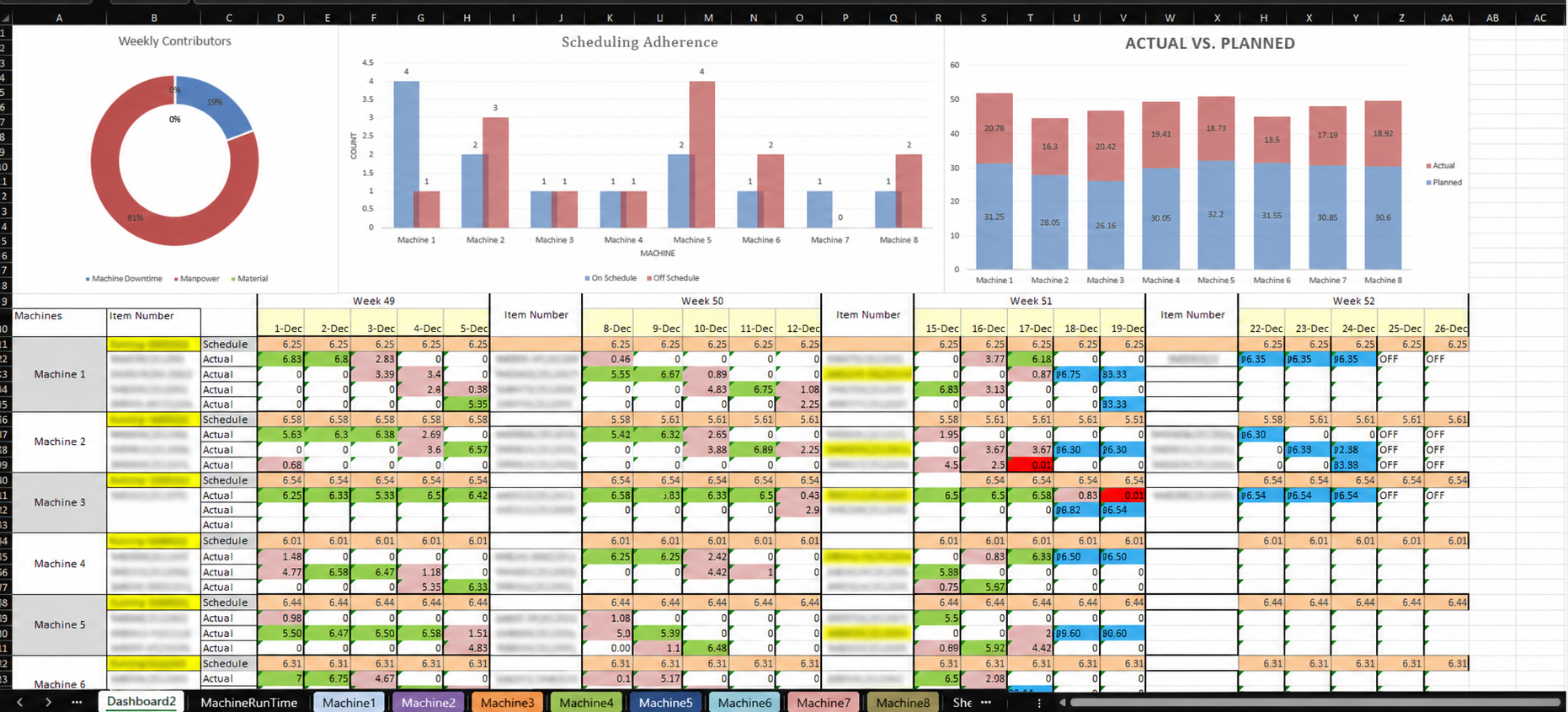
The Master Production Schedule translated production requirements into machine-level weekly schedules while providing visibility into planned versus actual output, scheduling adherence, and operational disruptions.
The system expanded forward production visibility while giving planning and operations a shared view of what was scheduled, what was actually produced, and where performance was deviating from plan.
Demand Forecasting & Capacity Planning
Historical customer and item-level demand was incorporated into a forecasting model to identify demand patterns, growth trends, and future production requirements.
Rather than treating forecasting as a standalone report, demand information was connected to the broader planning process so expected requirements could be evaluated against available capacity, work-in-process, material availability, and production constraints.
What it connected
• Historical demand
• Forecasting
• Capacity
• Work-in-process
• Material requirements
• Downtime
• Production scheduling
• Actual production performance
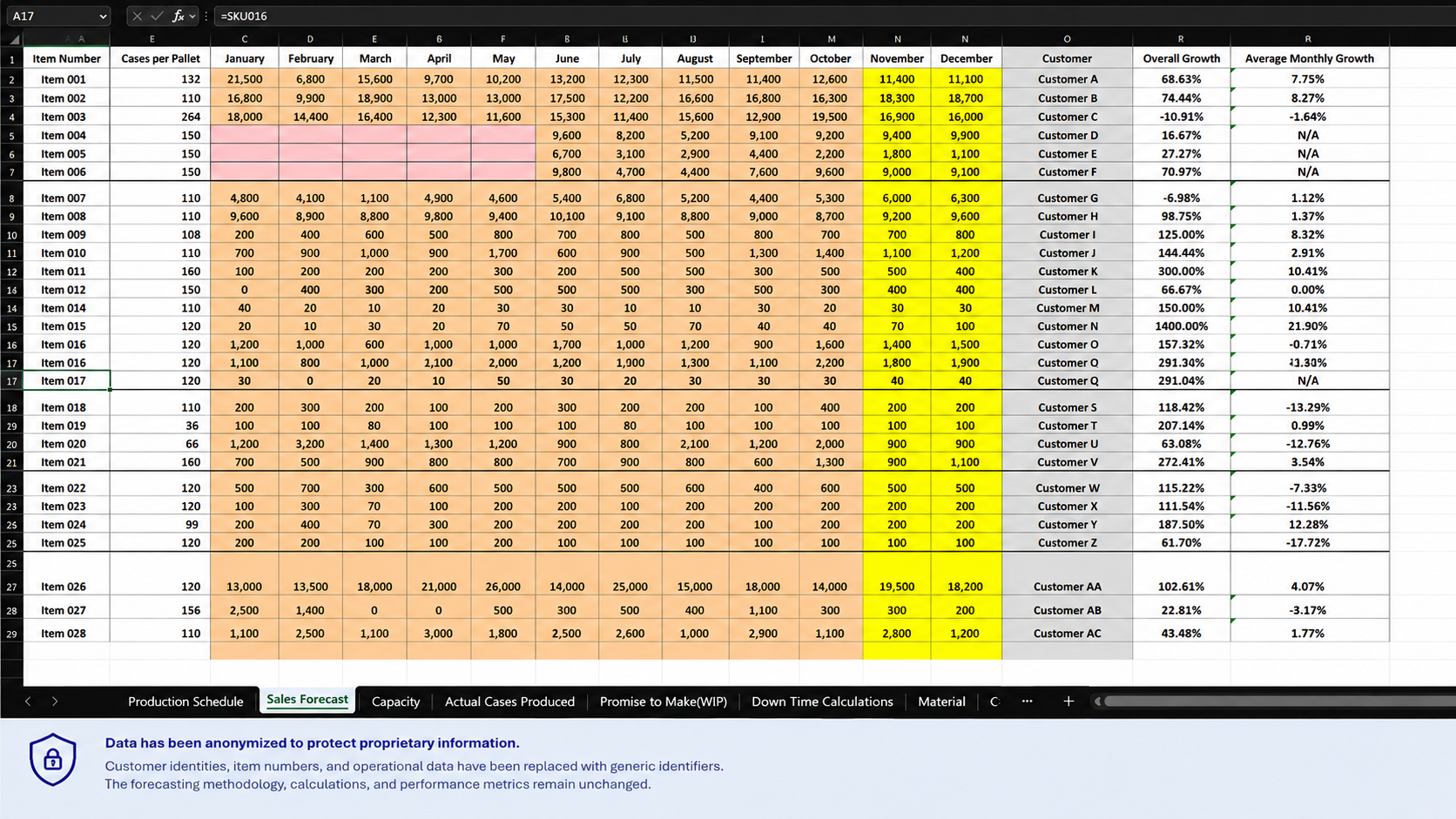
Demand Forecast → Capacity → WIP → Production Schedule → Actual Production → Downtime → Materials
The planning system was designed as a connected framework rather than a collection of standalone spreadsheets. Demand requirements flowed into capacity and production planning, while work-in-process, actual production, downtime, and material availability provided the operational feedback needed to continuously adjust the plan.
This created a single planning structure that connected what the business expected to produce with what operations could realistically execute.